

Introduction
Hair loss affects both men and women and affects millions globally. The condition is often frustrating, especially when results from conventional treatment methods feel slow or limited. In recent years, exosome therapy has started gaining attention as a more advanced, regenerative approach. Instead of just managing hair fall, Exosome for Hair Loss focuses on improving the health of the scalp and hair follicles at a deeper level. While it may sound complex, the idea behind it is surprisingly simple—and that’s exactly what makes it so appealing.
What Are Exosomes?
Exosomes are tiny nano-sized extracellular particles (30-150 nm) that are released by various cells, including stem cell therapy. These molecules act as tiny messengers that carry important signals between cells, helping them repair, regenerate, and function better.
Exosomes facilitate cell-to-cell communication among the hair follicles. Exosomes stimulate dormant hair follicles at the cellular level. It creates a supportive scalp microenvironment, improves long-term scalp health and hair growth.
Exosome for Hair Loss: How Does It Work?
Exosome treatment for Hair Loss are introduced into the scalp either topically or via microneedling. Exosomes begin interacting with hair follicles. Their main role is to deliver growth factors and signals that encourage repair and regeneration.
This Process Helps:
- Reactivate dormant hair follicles
- Activates hair follicle stem cells
- Improves blood circulation in the scalp, improves nutritional and oxygen supply
- Reduce inflammation around the dormant hair follicles
It creates a healthier environment for hair to grow. Rather than forcing quick results, exosomes support the natural growth cycle, which is why changes tend to appear gradually.
Who Can Benefit from Exosomes for Hair Loss?
Exosome therapy is generally considered for individuals experiencing early to moderate hair thinning. It may be helpful for conditions like pattern hair loss or stress-related shedding.
It tends to work best when hair follicles are still present but weakened. In cases where follicles are completely inactive or scarred, results may be limited. This is why early intervention often leads to better outcomes.
One must consult an experienced dermatologist for an effective solution.
What to Expect for Exosome Therapy?
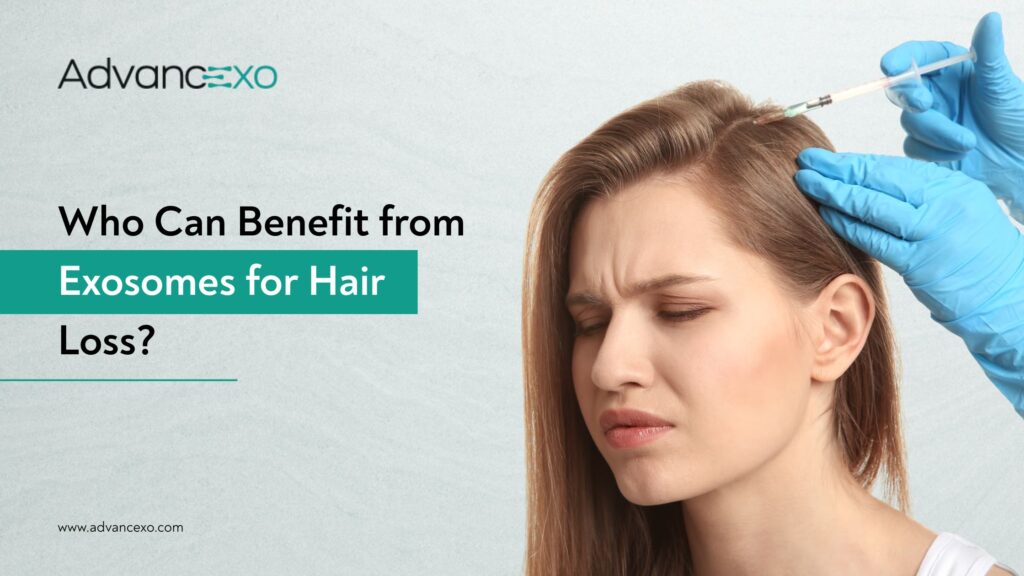
The procedure involves minimally invasive techniques. Exosomes are typically applied to the scalp using microinjections or combined with techniques like microneedling to enhance absorption.
The session takes around 30 to 60 minutes. The procedure has minimal lifetime, and most individuals return to their normal routine shortly after the procedure.
Some mild redness or sensitivity may occur initially, but this usually settles quickly. Since it’s not a surgical procedure, recovery is generally smooth and manageable.
What Results Should Be Expected?
Exosomes for Hair Loss Before and After Results depend on certain factors:
The result does not appear overnight; the changes appear with time. Hair growth follows a natural cycle, so visible changes take time.
Reduced hair shedding is noticed in the first few weeks
In the next few months, hair thickness and density improve visibly
In 4-6 months, healthier, fuller-looking hair appears
Benefits of Exosomes for Hair Loss
One of the main reasons people are drawn to exosome therapy is its regenerative approach. Instead of masking the problem, it works to improve the scalp environment.
Key benefits include:
- Non-surgical and minimally invasive
- Supports natural hair growth
- Little to no downtime
- Can be combined with other treatments
It also offers a more modern alternative for those who may not respond well to conventional options.
Are There Any Risks or Side Effects?
Exosome therapy is often reported to be safe when performed by trained professionals. Since it involves biological components, proper sourcing and handling are crucial.
Side effects, if any, are usually mild—such as temporary redness, slight swelling, or sensitivity at the treatment site.
Exosomes vs Conventional Treatment for Hair Loss
Traditional treatment options like PRP (platelet-rich plasma), medications, laser, hair transplantation, or Exosome treatment for Hair Loss have a distinct mechanism of action to combat the hair loss problem.
PRP uses an individual’s own blood to isolate platelets and inject them at the target site of the scalp. It stimulates growth, whereas exosomes deliver concentrated signaling factors directly. This may lead to more targeted effects in some cases. The effectiveness of the treatment depends on the underlying cause and the individual’s response.
Conclusion
Exosome therapy enables a shift toward more regenerative, science-driven solutions for hair loss. While it’s not a quick fix, it offers a promising option for those looking to improve hair health in a more natural, gradual way. In future, the focus must be on launching large-scale clinical trials for establishing safety and efficacy for the patient.