
Road construction is an industry where failure is expensive, visible, and politically inconvenient. A highway that develops ruts within three years of opening, a rural access road that turns into a mud channel after the first monsoon season, an industrial haul road that requires constant regrading — these are not engineering surprises. They are the predictable result of building on ground that was not adequately prepared to carry the loads placed on it.
The conventional response to weak subgrade — adding more aggregate, increasing base thickness, compacting harder — treats the symptom rather than the cause. It also adds significant material and transport cost to every project where it is applied. Geotextile fabrics address the cause directly, at a fraction of the cost of additional aggregate — and the performance data from highway authorities, infrastructure agencies, and long-term field monitoring programmes makes the case for their use consistently and clearly.
The Root Cause of Most Road Failures
To understand why geotextile fabrics improve road performance so significantly, it helps to understand exactly what happens beneath a road surface when it is built without one.
When a gravel or aggregate base layer is placed directly on natural subgrade soil — particularly soft, silty, or clay-bearing soil — vehicle loading causes a progressive mixing process. The aggregate particles are pushed downward into the soft soil under load, while soil is forced upward into the aggregate base. Over repeated load cycles, the base layer becomes contaminated with fine soil particles, its drainage capacity is destroyed, and its load-bearing performance degrades rapidly.
This contamination process accelerates in wet conditions. Saturated subgrade soil loses bearing capacity dramatically — and once the base layer has mixed with the subgrade, water that was previously draining freely is now trapped within the pavement structure, accelerating deterioration from below.
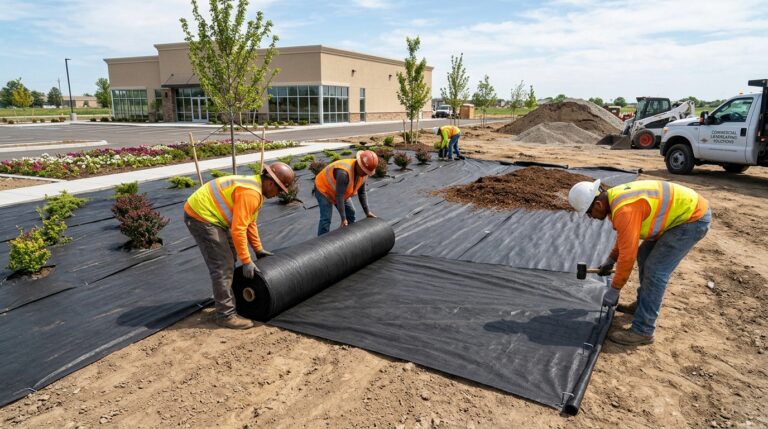
A stabilisation fabric installed between the subgrade and the base layer prevents this process entirely. The fabric acts as a permanent separator, keeping base aggregate and subgrade soil in their respective positions regardless of load cycles, water conditions, or time. The aggregate stays clean, the drainage layer functions as designed, and the road performs as built — not as the subgrade dictates.
What Stabilisation Fabric Actually Does in a Road Structure
The term stabilisation fabric is used specifically for geotextile products installed in the subgrade layer of road construction — as distinct from geotextiles used for filtration, drainage, or erosion control in other applications. Understanding the four functions these fabrics perform simultaneously clarifies why their impact on road performance is so significant.
- Separation is the primary function. The fabric maintains a clean interface between the granular base layer and the subgrade soil below. Geotextile fabric acts as a barrier between different soil layers, preventing the mixing of subgrade soil with overlying construction materials such as gravel or sand — maintaining the structural integrity of the roadway by preventing the intermixing of materials that can weaken the foundation.
- Reinforcement improves the load-bearing capacity of weak subgrade by distributing applied loads across a wider area. Rather than stress concentrating on individual weak points in the subgrade, the tensile strength of the fabric spreads that stress laterally — reducing the pressure at any single point and preventing the localised bearing failures that cause potholing and rutting.
- Filtration allows water to move vertically through the road structure while retaining fine soil particles at the fabric-soil interface. This prevents the drainage aggregate above the fabric from silting up over time — maintaining the drainage capacity of the base layer and preventing the water accumulation that destroys subgrade bearing capacity.
- Drainage in the cross-plane direction moves water away from the subgrade zone — reducing the pore water pressure that weakens soft soils under repeated loading and preventing the freeze-thaw damage that destroys road structures in climates with significant winter temperatures.
These four functions work together continuously throughout the service life of the road — which is why the performance improvement from correctly specified geotextile stabilisation fabric compounds over time rather than diminishing.
Polypropylene Woven Fabric: Why It Is the Standard for Road Stabilisation
Not all geotextile fabrics are appropriate for road stabilisation applications. The specific demands of subgrade reinforcement — high tensile loads from vehicle traffic, long service life requirements, installation under compaction equipment, and exposure to chemically variable subgrade conditions — make polypropylene woven fabric the standard specification for this application.
Woven geotextile fabric is manufactured by interlacing polypropylene tapes in a structured grid pattern. The weave construction gives it high tensile strength in both the warp and weft directions — typically ranging from 20 to 200 kN/m depending on the specification grade — which is the property that enables it to distribute subgrade stress effectively under heavy vehicle loading.
Woven geotextiles address common road failures such as cracking and potholes by stabilising weak subsoils, with roads incorporating woven geotextiles requiring 20% less maintenance over ten years — a documented performance improvement that translates directly into reduced lifecycle cost for road owners and operators.
Polypropylene as a base material offers chemical resistance across a broad pH range, making it compatible with the full range of natural subgrade soil conditions encountered in road construction — from acidic peat soils to alkaline clay subgrades. It does not absorb water, does not degrade in wet conditions, and with appropriate UV stabiliser additives, maintains its mechanical properties through decades of service in buried road applications.
Non-woven geotextile fabrics, while excellent for filtration and drainage applications in road construction, do not provide the tensile reinforcement performance of woven fabric at equivalent weights. For subgrade stabilisation where load distribution is the primary function, polypropylene woven fabric is the correct specification.
The Measurable Performance Impact: What the Data Shows
For procurement managers and infrastructure project sponsors evaluating the cost-benefit case for geotextile stabilisation fabric, the performance data from field monitoring and laboratory research is the most persuasive input available.
When properly selected and installed, geotextile stabilisation fabric can reduce rutting by 40 to 80%, decrease required aggregate base thickness by 25 to 50%, increase bearing capacity by 1.5 to 3 times on low CBR subgrades, and extend service life of roads by 2 to 4 times compared to roads built without geotextile.
The aggregate reduction figure deserves particular attention for procurement teams. A 25 to 50% reduction in required base aggregate thickness is not a marginal saving on a large infrastructure project — it is a material cost reduction that, across the full length of a major road project, can amount to a significant proportion of total construction cost. When that saving is set against the cost of the geotextile fabric itself, the return on investment case is straightforward.
Properly selected geotextile road fabrics increase pavement service life by 25 to 40%, reduce maintenance frequency by 20%, enhance subgrade strength by 35%, and lower construction material costs by up to 15%.
For government and infrastructure project buyers who evaluate road construction on whole-life cost rather than construction-phase cost alone, these figures represent a compelling argument for geotextile specification as standard practice rather than an optional enhancement.
Specification Variables That Determine Performance
The performance data above applies to correctly specified geotextile fabric. Underspecified fabric — selected on unit price rather than on tensile strength, puncture resistance, and AOS requirements matched to the specific project conditions — will not deliver these results.
The key specification parameters for road stabilisation fabric are:
- Tensile strength — matched to the design axle load and subgrade CBR (California Bearing Ratio) value. For light access roads on moderate subgrades, 20 to 40 kN/m is typically adequate. For highways and haul roads on soft subgrades with CBR values below 3, tensile strengths of 80 kN/m and above are the appropriate specification range.
- Puncture resistance — matched to the angularity and maximum particle size of the aggregate being placed above the fabric. Sharp-edged crushed aggregate requires higher puncture resistance specification than rounded river gravel. The installation process — specifically the compaction equipment used and the initial aggregate cover depth — also directly affects the puncture loads the fabric must resist without damage.
- Apparent Opening Size (AOS) — matched to the particle size distribution of the subgrade soil. The AOS must be fine enough to retain subgrade fines at the fabric interface without blinding, while allowing water to pass freely in the cross-plane direction.
- UV stabilisation — essential for any fabric that will be stored on-site before installation or that will remain exposed during staged construction. Specify a minimum of 1,500 hours UV resistance per ASTM D4355 for standard road applications.
| Application | Recommended Tensile Strength | GSM Range | Key Standard |
| Temporary access roads | 20–40 kN/m | 100–150 GSM | ASTM D4595 |
| Rural and low-volume roads | 40–80 kN/m | 150–200 GSM | AASHTO M288 |
| Highways and arterial roads | 80–150 kN/m | 200–300 GSM | ASTM D4632 |
| Heavy haul and industrial roads | 150–200+ kN/m | 300+ GSM | ASTM D4595 |
Installation: Where Specification Gains Are Won or Lost
A correctly specified fabric that is damaged during installation provides no benefit in service. The most common installation errors in road geotextile applications are placing aggregate directly onto the fabric from excessive drop heights — which causes puncture damage before the protective cover layer is in place — and using sharp-edged compaction equipment that cuts through the fabric during initial aggregate spreading.
Standard installation practice requires a minimum aggregate cover depth of 150 to 200 mm above the fabric before any compaction equipment is operated. The first aggregate layer should be spread by tracked equipment working away from already-spread material — not driving over the exposed fabric. Overlaps between adjacent fabric panels should be a minimum of 300 mm in the machine direction and 500 mm at transverse joints, with the upslope panel lapping over the downslope panel to prevent water from tracking along the overlap joint.
These are not complex requirements. But they are consistently where specification gains are lost in the field — making pre-installation contractor briefing and quality assurance inspection during fabric placement as important as the specification decision itself.
The Commercial Case for Geotextile Fabrics in Road Construction
Road construction procurement decisions are made under cost pressure. Geotextile stabilisation fabric adds a line item to the construction budget that is visible at tender stage. The aggregate reduction it enables, the maintenance savings it generates, and the extended service life it delivers are distributed across years and decades of road operation — and therefore less visible in a project cost comparison.
The practical approach for procurement teams and project sponsors is to evaluate geotextile specification on whole-life cost rather than construction-phase cost alone. When the aggregate savings enabled by fabric installation are quantified, the net cost of geotextile specification is typically neutral to positive at the construction phase — before any maintenance or service life benefits are counted.
For infrastructure projects funded on lifecycle cost models, the case is even stronger. A road built with correctly specified geotextile stabilisation fabric will require significantly less maintenance expenditure over its design life than one built without it — delivering a return on the fabric investment that accumulates throughout the operational life of the asset.
Specifying geotextile fabrics for an upcoming road construction or infrastructure project? Define your subgrade CBR value, design axle load, and aggregate specification before selecting a fabric grade — and request certified tensile strength and puncture resistance test data from your manufacturer before committing to bulk volumes.