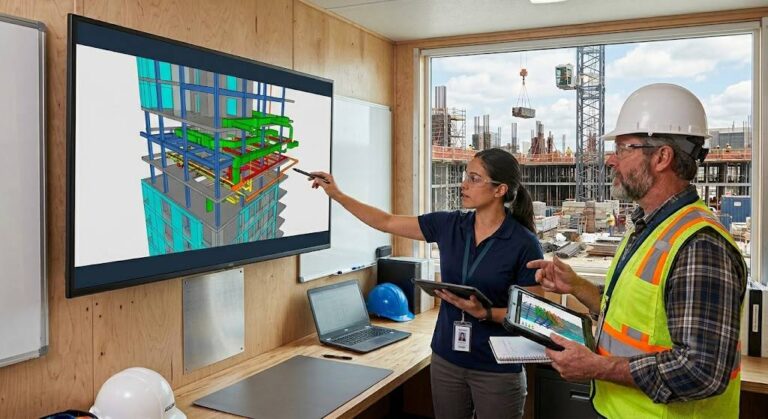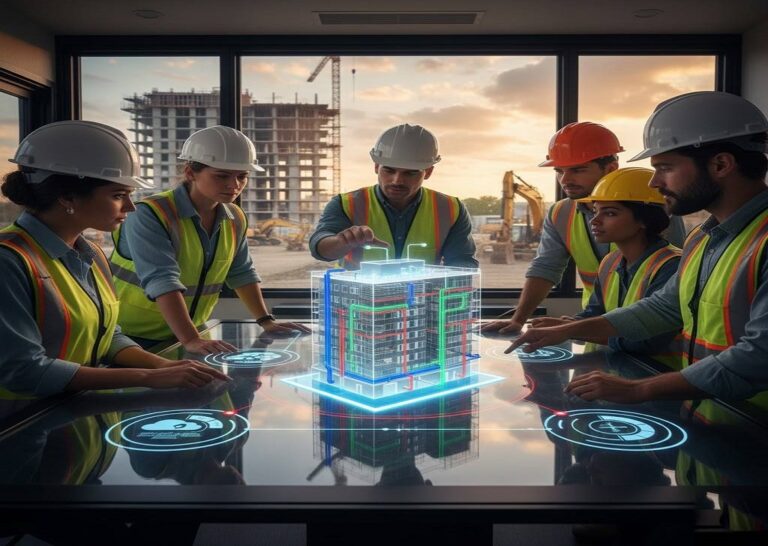

The mechanical contracting landscape in the United States is more competitive than it has ever been. Owners are demanding faster schedules, tighter budgets, and more accurate documentation. General contractors are requiring BIM deliverables as a baseline contract condition. And the mechanical firms that are winning the best commercial projects are not simply the ones with the lowest bids. They are the ones that have built a technology-driven delivery model that produces better outcomes at every phase of a project.
This is not a trend that is coming. It is already here. And the gap between mechanical contractors who have adopted these tools and those who have not is widening with every project cycle.
Why Technology Adoption Is Now a Survival Issue?
For years, technology adoption in mechanical contracting was optional. A firm could run a successful business on experienced foremen, hand-drawn coordination sketches, and phone calls to resolve field conflicts. That era is functionally over for contractors pursuing commercial work above a certain volume threshold.
The shift is driven by three compounding pressures. First, project complexity has increased as buildings pack more systems into less space. Second, labor costs have risen sharply, as highlighted by recent construction labor shortage data, making field rework far more expensive than it was a decade ago. Third, general contractors and owners have raised their baseline expectations for coordination quality, BIM deliverables, and prefabrication capability.
Mechanical contractors who cannot meet these expectations are being filtered out of bid lists. Those who can are building the kind of preferred subcontractor relationships that sustain a business through market cycles.
BIM Coordination as the Competitive Foundation
The single most impactful technology shift for mechanical contractors in the past decade has been the adoption of Building Information Modeling as a core project delivery tool rather than a GC-mandated checkbox.
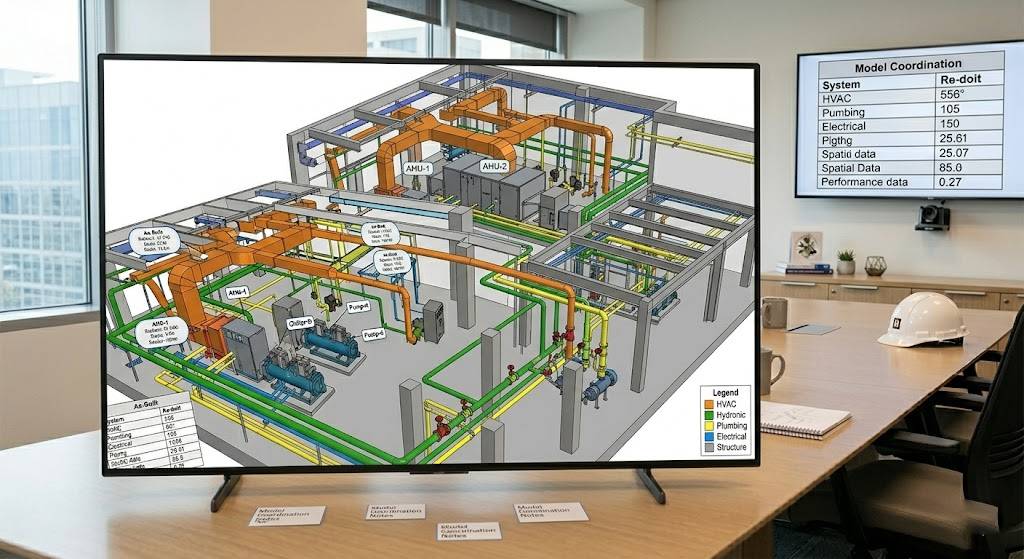
BIM for Mechanical Contractors means building a fully detailed, LOD-compliant model of HVAC systems, hydronic piping, process piping, and associated equipment before installation begins. That model is then federated with structural, electrical, and plumbing models to identify spatial conflicts through automated clash detection and coordination using BIM.
From Reactive to Proactive Coordination
The traditional coordination model was reactive. Conflicts were discovered in the field, resolved through RFIs and change orders, and absorbed as cost overruns. The BIM-driven model is proactive. Conflicts are identified in the pre-construction phase through MEP coordination services, resolved digitally, and eliminated before a crew ever mobilizes.
Clash detection and coordination services have matured to the point where mechanical contractors can access this capability even without a large in-house VDC team. Third-party BIM coordination providers can federate trade models, run clash detection, facilitate coordination meetings, and deliver approved, conflict-free models on project timelines that work for both pre-construction and active construction phases.
According to Autodesk, contractors that implement model-based coordination consistently report measurable reductions in RFI volume and change order frequency compared to projects delivered with traditional 2D coordination methods.
Prefabrication Powered by Accurate Models
The mechanical contractors pulling ahead of their competition are not just using BIM for coordination. They are using it as the foundation for a prefabrication workflow that fundamentally changes how their field crews operate.
When a mechanical model is coordinated and approved, spool drawings and cut lists can be generated directly from the model geometry. Those outputs go to the fabrication shop without manual redrawing, reinterpretation, or measurement. Fabricated assemblies, ductwork spools, pipe racks, equipment skids, are tagged to match model elements and delivered to the site in installation sequence.
The result is a field crew that installs rather than fabricates. Labor hours per unit of installed work drop. Quality improves because shop fabrication is more consistent than field fabrication. And schedule certainty increases because the variables of field measurement and fit-up are removed from the critical path.
This is the model that the most productive mechanical contractors in the country are running, and BIM accuracy is the prerequisite that makes it possible.
Digital Twins and As-Built Documentation
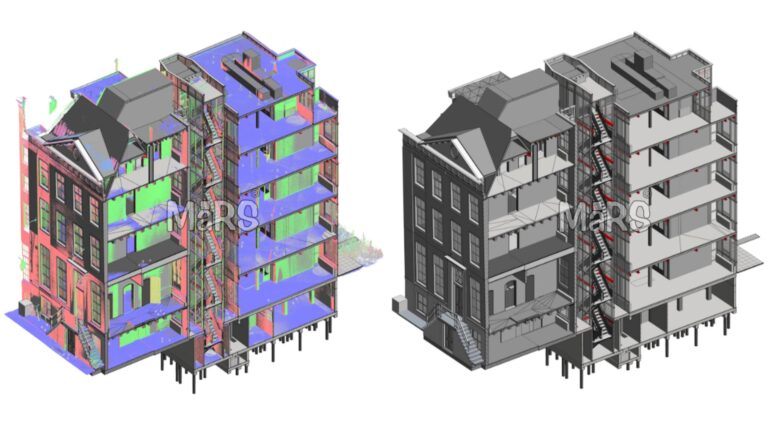
The technology advantage does not stop at installation. Leading mechanical contractors are using their coordinated BIM models as the foundation for as-built modeling deliverables that owners and facility managers increasingly require at project closeout.
An accurate as-built model documents every installed system with spatial precision, equipment data, and specification references. For building owners managing facilities over a 30 to 50-year lifecycle, this data has significant operational value. For mechanical contractors, the ability to deliver a high-quality as-built model is a differentiator that separates them from competitors who hand over a set of red-lined 2D drawings at closeout.
As the construction industry moves toward digital twin frameworks, where the virtual building model is maintained and updated throughout the building’s operational life, mechanical contractors who can deliver BIM-quality as-built documentation are positioning themselves as long-term partners rather than one-time trade contractors.
MEP BIM Coordination as a Cross-Trade Advantage
Mechanical contractors who operate within a fully coordinated MEP BIM environment benefit not only from resolving their own system conflicts, but from the downstream coordination precision that BIM for Plumbing Contractors and electrical coordination bring to shared spaces.
Mechanical and plumbing systems share shafts, equipment rooms, and ceiling spaces on virtually every commercial project. When plumbing models are developed and coordinated alongside mechanical models within a structured MEP BIM coordination process, the conflicts between these closely related systems are resolved before either trade mobilizes. That means fewer field adjustments, fewer penetration conflicts, and smoother equipment room installations.
Similarly, the coordination relationship between mechanical systems and the electrical infrastructure managed by the GC’s broader team is where BIM for General Contractors frameworks provide the most value for mechanical subcontractors. When the GC is running a structured BIM coordination environment, mechanical contractors who enter that environment with a compliant, accurate model gain the benefit of full MEP BIM coordination services without having to independently manage the entire process.
What Staying Ahead Actually Requires?
The mechanical contractors that are winning in today’s U.S. construction market have made a deliberate choice to treat technology capability as a core business investment rather than a project-by-project expense. That investment takes several forms.
In-house or outsourced BIM capability — Either developing internal VDC staff who can model, coordinate, and generate fabrication outputs, or building a reliable relationship with a BIM services provider who can deliver those outputs consistently across a project portfolio.
Prefabrication infrastructure — A shop environment, whether owned or through a fabrication partner, that can execute on BIM-generated spool drawings and deliver tagged assemblies on a project schedule.
Project management integration — Using construction technology platforms to connect model-based coordination with submittal tracking, procurement milestones, and schedule management so that technology is embedded in how the business runs, not siloed as a separate function.
The gap between mechanical contractors who have made this investment and those who have not is already visible in who is getting invited to bid on the most desirable commercial projects. Over the next five years, that gap will only widen.
The firms that act now build the capability while the learning curve is manageable. The firms that wait will be building it under competitive pressure, which is a significantly harder place to start.