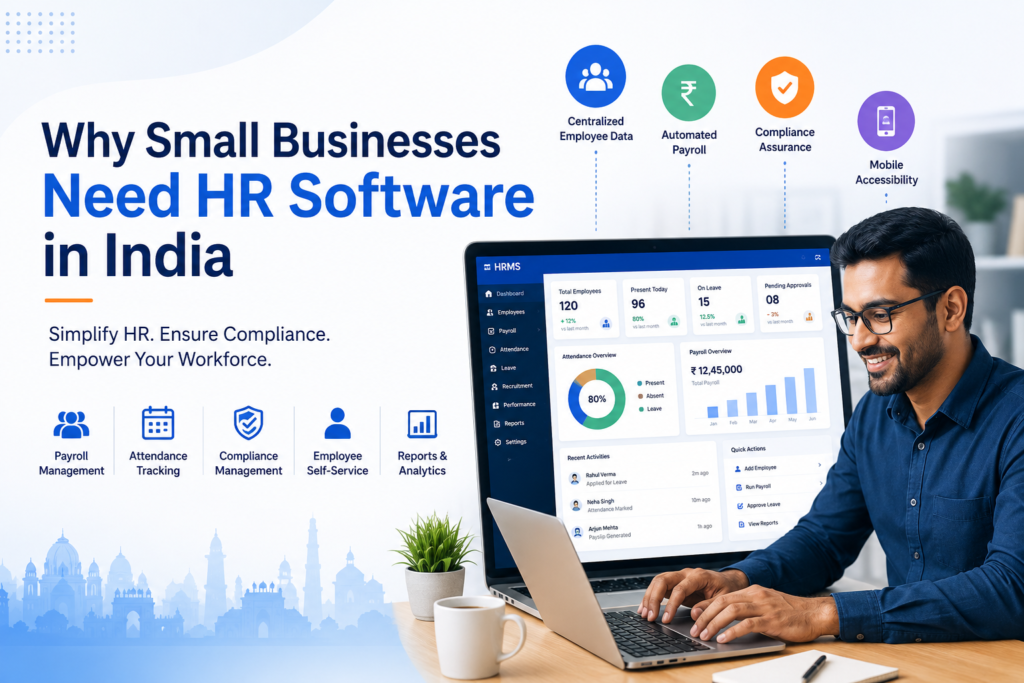
Running a small business in India is no easy task. From managing employees and payroll to ensuring statutory compliance and maintaining attendance records, HR responsibilities can quickly become overwhelming. Many small businesses still rely on spreadsheets, manual registers, and outdated processes, which often lead to errors, delays, and compliance risks.
This is where HR software becomes essential.
Modern HR software helps small businesses automate routine HR tasks, improve workforce productivity, ensure compliance, and create a better employee experience—all while saving time and operational costs.
In this blog, we will explore why small businesses in India need HR software, its key benefits, must-have features, and how choosing the right HRMS can support long-term business growth.
What is HR Software?
HR software, also known as Human Resource Management Software (HRMS), is a digital solution designed to manage employee-related tasks and HR operations from a single platform.
It helps businesses handle:
- Employee database management
- Attendance and leave tracking
- Payroll processing
- Statutry compliance
- Recruitment and onboarding
- Performance management
- Employee self-service
- Reports and analytics
Instead of handling these functions manually, businesses can automate workflows and reduce administrative burden.
For small businesses, HR software acts as a productivity tool that simplifies operations and supports business scalability.
Challenges Faced by Small Businesses Without HR Software
Many startups and SMEs assume HR software is only for large enterprises. However, the absence of a proper HR system creates more challenges for smaller businesses.
1. Manual Payroll Errors
Salary calculations involving PF, ESI, PT, TDS, bonuses, and deductions can become highly complex. Manual payroll increases the chances of errors and employee dissatisfaction.
2. Compliance Risks
Indian labor laws require businesses to stay compliant with regulations like:
- Provident Fund (PF)
- Employee State Insurance (ESI)
- Professional Tax (PT)
- Labour Welfare Fund (LWF)
- TDS deductions
- Shops and Establishment compliance
Missing deadlines or filing incorrect returns can result in heavy penalties.
3. Poor Attendance Tracking
Manual attendance registers or spreadsheets often create confusion regarding late entries, overtime, shifts, and leave balances.
4. Lack of Employee Records
Without centralized data, finding employee documents, salary history, and leave records becomes difficult and time-consuming.
5. Limited HR Visibility
Business owners struggle to track workforce productivity, attrition, absenteeism, and department-wise performance without proper reporting tools.
Why Small Businesses Need HR Software in India
1. Payroll Automation Saves Time
Payroll is one of the most critical HR functions. HR software automates salary calculations, tax deductions, reimbursements, and payslip generation.
Benefits include:
- Accurate salary processing
- Auto tax calculations
- Faster payroll closure
- Error-free payslips
- Direct bank integration
This reduces dependency on manual processes and improves employee trust.
2. Better Compliance Management
Compliance mistakes can be costly for small businesses.
HR software helps automate:
- PF and ESI calculations
- Statutory deductions
- Compliance reports
- Form generation
- Filing reminders
This ensures businesses remain compliant with Indian labour laws without constant manual monitoring.
3. Attendance and Leave Management
Tracking attendance manually creates confusion and payroll disputes.
HR software offers:
- Biometric integration
- Geo-fencing attendance
- Mobile attendance
- Shift scheduling
- Leave approvals
- Holiday calendars
- Overtime tracking
This improves transparency and saves HR teams significant time.
4. Employee Self-Service Portal
Employees no longer need to contact HR for every small request.
Using self-service portals, employees can:
- Download payslips
- Apply for leave
- Check attendance
- Update personal details
- Submit claims
- Access tax documents
This reduces HR workload and improves employee satisfaction.
5. Improved Hiring and Onboarding
Recruitment is often unstructured in small businesses.
HR software helps streamline:
- Candidate tracking
- Interview scheduling
- Offer letter generation
- Document collection
- Joining formalities
- Digital onboarding
This creates a professional hiring experience and improves retention.
6. Better Data Security
Employee information is sensitive and should not be stored in unsecured spreadsheets.
HR software provides:
- Role-based access
- Cloud storage
- Data encryption
- Backup systems
- Secure document management
This improves confidentiality and prevents data loss.
7. Real-Time Reports and Analytics
Smart business decisions require accurate workforce data.
HR software offers reports on:
- Payroll summaries
- Leave trends
- Attendance reports
- Employee turnover
- Department productivity
- Compliance status
These insights help small businesses plan growth strategically.
8. Cost Savings in the Long Run
Although many small businesses hesitate due to software costs, HR software actually reduces expenses by:
- Minimizing payroll errors
- Avoiding compliance penalties
- Reducing manual HR effort
- Improving employee retention
- Saving administrative costs
The return on investment is often much higher than the subscription cost.
Must-Have Features in HR Software for Small Businesses
When selecting HR software, small businesses should look for these features:
Payroll Management
Automated salary processing with compliance support.
Attendance Management
Biometric, mobile, and shift-based attendance tracking.
Leave Management
Custom leave policies with approval workflows.
Employee Self-Service
Employee access to payslips, leave, and personal records.
Compliance Automation
PF, ESI, PT, TDS, and statutory reporting.
Recruitment Management
Hiring workflow and onboarding automation.
Mobile Accessibility
Access HR operations anytime from mobile devices.
Reports and Dashboard
Real-time insights for better decision-making.
How HR Software Supports Business Growth
As businesses grow, HR complexity increases.
Without software:
- More employees mean more manual work
- Compliance risks multiply
- Payroll becomes harder to manage
- Employee engagement drops
With HR software:
- Processes scale smoothly
- HR operations remain organized
- Management gets better control
- Employees enjoy a better work experience
This makes HR software a growth enabler, not just an HR tool.
Why Cloud-Based HR Software is Better for SMEs
Cloud HR software is especially beneficial for small businesses because it offers:
- Lower upfront costs
- No server maintenance
- Remote accessibility
- Automatic updates
- Better scalability
- Faster implementation
This makes it ideal for startups, SMEs, and growing businesses across India.
Choosing the Right HR Software in India
Before selecting HR software, businesses should evaluate:
- Ease of use
- Customer support
- Mobile app availability
- Compliance features
- Customization options
- Pricing structure
- Integration capabilities
- Scalability for future growth
Choosing the right HRMS ensures long-term operational efficiency.
Final Thoughts
Small businesses can no longer afford to manage HR manually.
In today’s competitive business environment, efficiency, compliance, employee satisfaction, and scalability are essential for growth. HR software helps businesses achieve all of these while reducing administrative burden and operational risks.
Whether it is payroll, attendance, compliance, or employee engagement, investing in HR software is no longer optional—it is a strategic necessity.
For Indian SMEs and startups, the right HRMS can transform HR from a routine administrative task into a powerful business growth engine.
If your business is still managing HR through spreadsheets and manual processes, now is the right time to upgrade.
Because smart businesses do not just manage employees—they empower them.
Also Read: Top HR Software for Remote Workforce Management